

By Gordon Graham |
In collaboration with Microsoft Copilot, AI companion for theological and technical resource-building
October 2025
🪶 Introduction: 400 Years and Counting
The Protestant Reformation of the 16th century was not merely a historical event—it was a theological earthquake. Its tremors reshaped the church, the conscience, and the culture. Now, nearly 400 years since the Westminster Assembly (1643–1653), we stand at another threshold. The digital age has brought new challenges to biblical fidelity, ecclesial identity, and theological clarity.
May this Neo-Reformation be not a rupture—but rather a providential shaking, removing what is transient so that what is unshakable may endure, cf. Hebrews 12:27. It is a return to Scripture, to the gospel, and to the covenantal roots that anchor us in Christ. It is a call to reform not by novelty, but by necessity. Not by innovation, but by illumination.
🔄 Semper Reformanda: Always Reforming
The phrase Ecclesia reformata, semper reformanda—“the church reformed, always reforming”—is not a license for doctrinal drift. It is a summons to continual repentance, renewal, and recalibration under the authority of Scripture.
- Confessional humility: We honor the historic creeds and confessions as faithful witnesses, yet remain open to reform where exegesis demands it. The goal is to be faithful both to Holy Scripture and the principles of Reformed theology.
- Textual fidelity over inherited application: Where confessional boundaries intersect with contested texts—we must ask afresh: What does the text mean, in context, to whom, and why?
- Pastoral urgency: Every generation must ask, Are we still faithful? Are we still clear? Are we still thinking covenantally—anchored in the promises of God and shaped by the corporate life of His people—rather than drifting toward isolated, individualistic faith?
This is not about chasing trends. It’s about chasing truth—even when it leads us to reconsider cherished formulations.
📖 Sola Scriptura: Scripture Alone
At the heart of every true reformation is a rediscovery of the Word of God—not as ornament, but as authority.
- Scripture is sufficient: Not just for salvation, but for doctrine, worship, and life.
- Scripture is supreme: No tradition, council, or culture can override its voice.
- Scripture is clear: Though not all parts are equally plain, the gospel shines brightly for all who seek it.
“The whole counsel of God…is either expressly set down in Scripture, or by good and necessary consequence may be deduced from Scripture…“
— Westminster Confession of Faith, 1.6
For example, while the word ‘Trinity’ is absent from Scripture, the doctrine is affirmed by good and necessary consequence—just as the Westminster Confession teaches. The unified witness of Father, Son, and Holy Spirit emerges not from a single proof-text, but from the full counsel of God.
In an age of noise, sola Scriptura is our tuning fork. It brings harmony to the church and clarity to the soul.
📚 Interlinear: Between the Lines
“It’s All Greek to Me… or Hebrew, as the Case May Be”
This section celebrates the sacred precision of the original languages and the theological weight they carry. It’s where syntax meets sanctity.
🧬 Access to the Original Languages
- Hebrew (OT): Rich in poetic parallelism, covenantal nuance, and wordplay. Think hesed, shalom, berith—each a theological treasure chest.
- Greek (NT): Surgical in its grammar, layered in its vocabulary. Participles, moods, and cases shape doctrine like chisels on stone.
- Aramaic: A few key passages (e.g., parts of Daniel, Jesus’ cry from the cross) remind us of the linguistic diversity of Scripture.
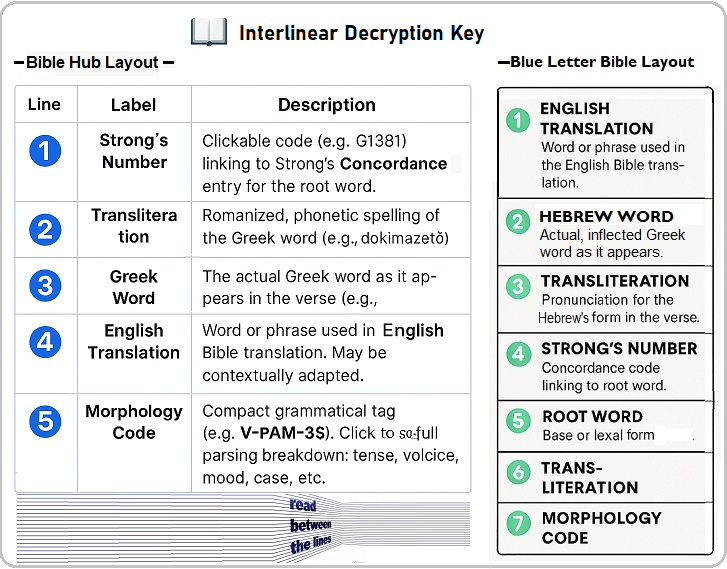
Interlinear tools let you walk the tightrope between translation and original intent. They’re like exegetical X-rays.

[Bible Hub Greek Interlinear apparatus display of 1 Cor. 11:28]
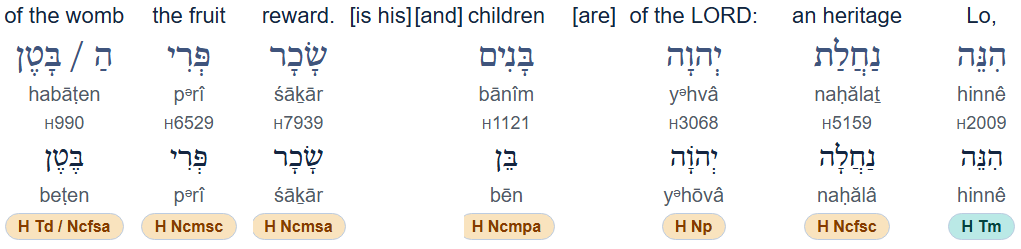
[Blue Letter Bible Hebrew Interlinear apparatus display of Psalm 127:3]
⚓ Confessional Anchor: WCF on Inerrancy
“The Old Testament in Hebrew…and the New Testament in Greek…being immediately inspired by God, and, by His singular care and providence, kept pure in all ages, are therefore authentic.“
— Westminster Confession of Faith, 1.8
This quote affirms:
- Inspiration: The original autographs are God-breathed.
- Preservation: God has providentially guarded the purity of the text.
- Authenticity: The originals are the final court of appeal in doctrinal disputes.
⚙️ Why It Matters
- Translation ≠ Interpretation: Every translation is an interpretive act. Knowing the original helps you spot where theological bias might sneak in.
- Word Studies: Greek logos vs rhema, Hebrew yada vs daath—these aren’t just synonyms; they shape how we understand revelation, knowledge, and relationship.
- Syntax: The grammatical arrangement of words in sentences can change the theological center of gravity.
🖼️ Hermeneutics: The Art of Sacred Decoding
Hermeneutics is the umbrella term—the theory and methodology of interpretation. It asks: How do we rightly understand what the text means? Not just what it says, but what it intends.
- Presuppositions matter: Everyone brings a lens. Hermeneutics helps us clean that lens—or at least name it.
- Context is king: Historical, literary, theological, and canonical context all shape meaning.
- Genre awareness: You don’t read apocalyptic like epistle. Hermeneutics teaches you to respect the genre’s rules.
📜 Historical-Grammatical Method: The Reformed Workhorse
This method is the backbone of conservative Protestant exegesis. It’s like a theological microscope and time machine rolled into one.
- Historical: What did the author mean in his time, to his audience? What cultural, political, and religious factors shaped the message?
- Grammatical: What do the words and syntax actually say? This is where Greek participles and Hebrew parallelism get their moment in the sun.
- Objective goal: To uncover the authorial intent, not impose our own.
Think of it as the opposite of “vibe-based” reading. It’s not asking, “What does this mean to me?” but “What did this mean then—and therefore, what does it mean now?”
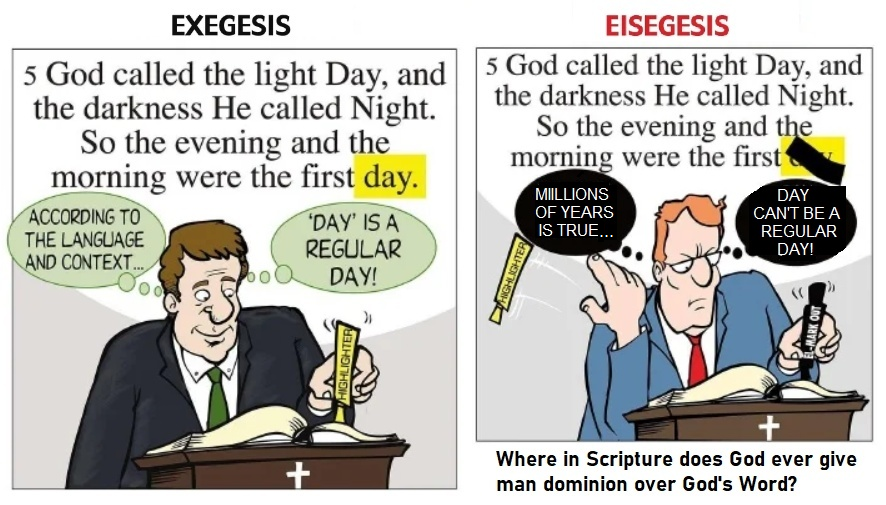
🕵️♂️ Exegesis vs Eisegesis: The Battle of the Prefixes
This is where the rubber meets the scroll.
| Term | Meaning | Method | Danger Level |
| Exegesis | “To lead out” | Drawing meaning from the text | 🟢 Biblical fidelity |
| Eisegesis | “To lead in” | Reading meaning into the text | 🔴 Theological malpractice |
📚 The Epistles as Occasional Documents
“The epistles are not theological treatises; they are letters written to specific churches or individuals to deal with specific issues. Their theology is always task theology—written for or in response to particular occasions.“
— Gordon D. Fee, New Testament Exegesis
This insight opens the door for contextual reexamination: if apostolic instruction is shaped by the situational circumstances at a particular church in the 1st century, then the universal application must be carefully parsed through historical-grammatical lenses—not merely inherited tradition.
As the kingdoms of the world have become the kingdoms of our Lord and of His Christ (Revelation 11:15), who is making all things new (Revelation 21:5), and the creation itself will be delivered from the bondage of corruption into the glorious liberty of the children of God (Romans 8:21), let the church be exhorted to prayerful reflection, devoted attention to intensified study of God’s Word, earnest discussion and positive action towards Reformation in our time.


